Registers and Memory
Registers
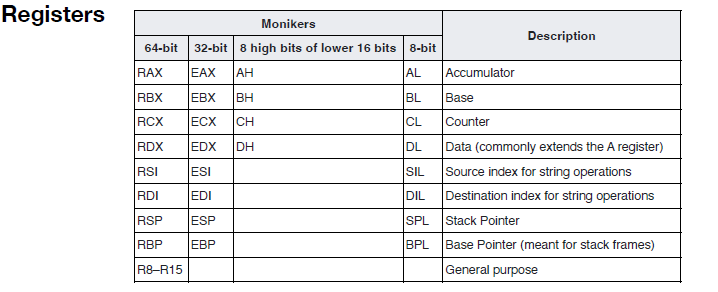
Small but extremely fast units of storage for the CPU. Referenced by name.
- General Purpose Registers for computations etc.
- Special Purpose Registers that store the instruction pointer (program counter) etc.
Memory (RAM)
Large(r) chunk of data. Referenced by address.
- Contains code, heap, and stack.
Data Movement :
mov dst, src- Move data fromsrctodstpush src- Pushsrconto the stackpop dst- Pop value from the stack and store it in thedst
Warning
There exists two flavours for the x86-64 syntax. We use the Intel syntax. The AT&T syntax swaps some of the arguments (and registers have a % before the name).
gdb defaults to the AT&T syntax, you can switch with:
set disassembly-flavor intel
Common Instructions
Arithmetic :
add dst, src-dst += srcsub dst, src-dst -= srcimul dst, src-dst *= src(signed multiply) After an arithmetic operation, flags are set :- ZF : zero flag, set to 1 if the result is 0.
- SF : sign flag, set to 1 if the result is negative.
- OF : overflow flag, set to 1 if the operation overflowed.
Control Flow
jump label- Jump to labelcall fn- Pushes instruction pointer (IP) onto stack, jump to function.ret- Pops IP from stack (and continues there).cmp a, b- Calculates b-a and sets flags.tst a, b- Calculatesa&band sets flags.je label- Jumps to label if zero flag is set.jne label- Jumps to label if zero flag is not set.nap- No-op instruction – doesn’t do anything.
Bitwise Operations :
and dst, src-dst &= srcor dst, src-dst |= srcxor dst, src-dst ^= src
Memory Addressing
Square brackets indicate that the operand is a memory address, rather than a direct value or register.
- Direct Memory Access :
[address]Example:mov eax, [0x1234] ;Move the value at address 0x1234 intoeax. - Register-based Memory Access :
[register]Example:mov eax, [ebp] ;Move the value at the address inebpintoeax.- Optionally with offset :
[register + offset]Example :mov eax, [rbp-4
- Optionally with offset :
Common Patterns
Data is moved to a register, operation is called, result stored in memory location or register.
mov eax, [esp+1] ; eax = [esp+1]
add [esp+18], eax ; [esp+18] += eax
Data is compared and then a jump is made based on the result.
cmp [esp+1], 3 ; if ([esp+1] == 3)
je label1      ; jump to label1
			   ; else continue below
The Stack
Note
The top of the stack is the lowest address that belongs to the stack.
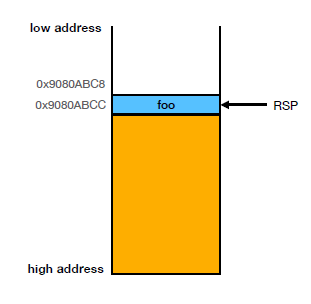
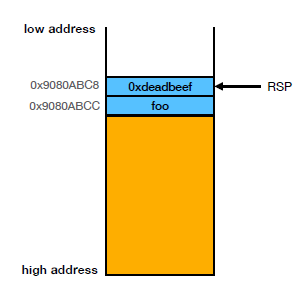
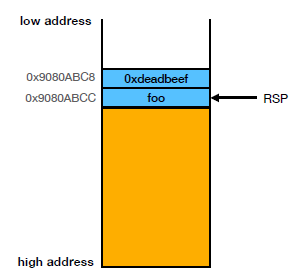
- The RSP (stack pointer) always points to the top of the stack.
- The
push raxinstructions is equivalent to
sub rsp, 8
mov [rsp], rax- The
pop raxinstruction is equivalent to :
mov rax, [rsp]
add rsp, 8
Calling Conventions (Linux)
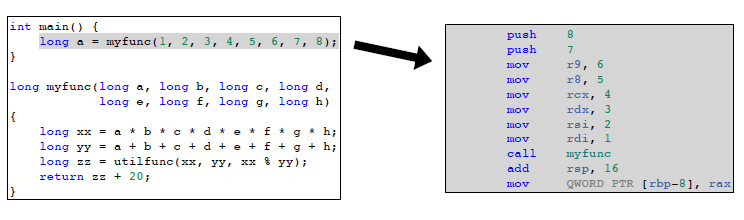
There exists a convention on how function arguments should be passed.
- The first 6 integer and pointer arguments should be passed by register (
rdi, rsi, rdx, rcx, r8, r9). - Any further argument is passed on the stack.
- Result is normally passed in
rax.
int main() {
	long a = myfunc(1, 2, 3, 4, 5, 6, 7, 8);
}
long myfunc(long a, long b, long c, long d, long e, long f, long g, long h)
{
	long xx = a * b * c * d * e * f * g * h;
	long yy = a + b + c + d + e + f + g + h;
	long zz = utilfunc(xx, yy, xx % yy);
	return zz + 20;
}