Bayesian Networks are probabilistic graphical models that use the direction of edges to represent the cause-effect relationship Bayes’ theorem for probabilistic inference.
Advantages :
- Graphical representation : Provides a visual representation of joint probability distributions of different random variables interpretability.
- Powerful : Can capture complex relationships between random variables.
- Combine data and prior knowledge : Incorporates prior knowledge and updates with statistically significant information from data.
- Generative approach : Able to generate new data similar to existing data.
Disadvantages :
- Requires prior knowledge of many probabilities.
- Sometimes computationally intractable.
Main Problems in Bayesian Network :
Another example of Bayesian Network :
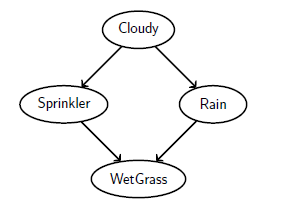
Three Main Tasks needed with Bayesian Networks :
- Inference : From observations (e.g., “it’s cloudy”) infer the probability of the wet grass.
- Training : Learn the model parameters
- Structure Determination : Identify what is connected to what
Bayesian Networks : Representation
Problem : How to represent the joint probability distributions of random variables ? Solution:
- A Bayesian network is a directed, acyclic graph (DAG), which consists of :
-
A set of nodes : each represents a random variable.
-
A set of directed edges connecting those nodes, example

-
The directed edges represents “Directed dependency” or “directed influence”, also called “direct cause”
-
- A conditional distribution for each node given its parents :
Discrete Random Variables :
Conditional distribution can be represented as a conditional probability tables (CPT) - the distribution over for each combination of parent values.
Loops are not allowed in a Bayesian network